
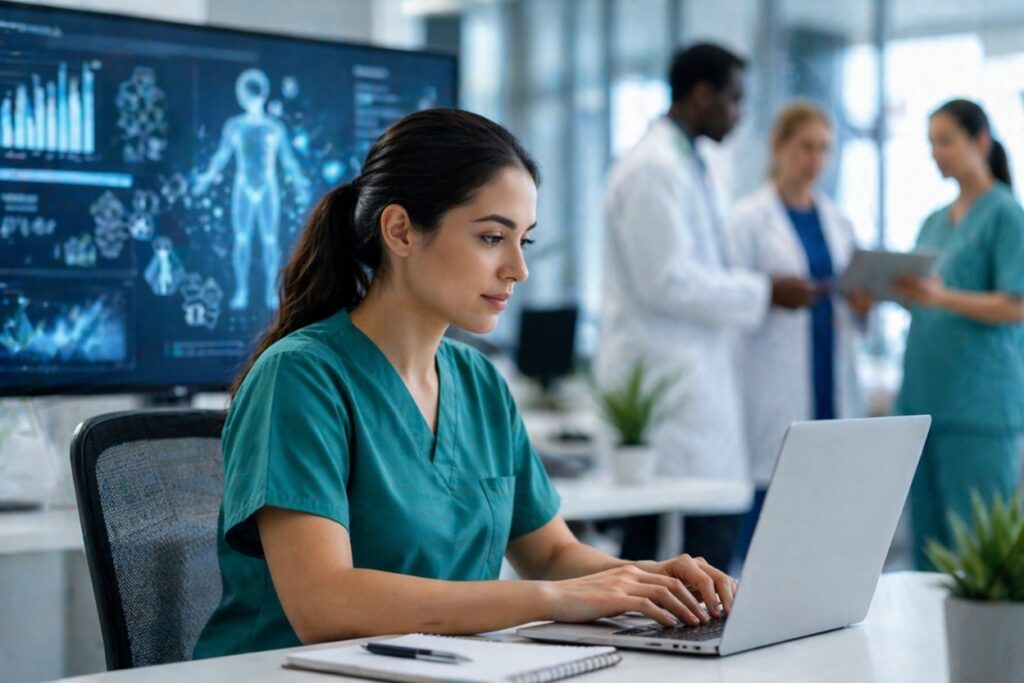
At a glance:
- Short, skills-focused learning designed for working professionals
- Often online and flexible
- Builds practical knowledge in areas like health informatics, EHR workflows, and healthcare data
- Supports continuing education and professional development goals
In today’s healthcare environment, professionals work in a field shaped by rapid technological change, evolving patient needs, and the growing use of data systems. Continuous learning helps professionals keep skills current and build new capabilities.
One option for focused professional development is a microcredential. At USF Health Morsani College of Medicine, microcredentials provide flexible, skills-based learning opportunities that help professionals build knowledge in areas such as health informatics and related disciplines.
What Is a Microcredential?
A microcredential is a short, focused learning program intended to validate specific skills or competencies within a professional field.
Compared to traditional degree programs, microcredentials are typically:
- Focused on specific subject areas
- Shorter in duration
- Structured around practical applications
- Designed with flexibility for working professionals
Why Microcredentials Are Used in Healthcare
Healthcare systems increasingly rely on digital tools, data analysis, and coordinated care models. Technologies such as electronic health records (EHRs) and analytics platforms are commonly used to support both clinical and administrative functions.
As these systems evolve, professionals may seek opportunities to build familiarity with tools and processes used in healthcare environments. Microcredentials can provide a structured way to explore these topics.
Potential Benefits of a Microcredential
1. Focused Skill Development
Microcredentials concentrate on specific skills that can be applied in professional settings.
Example:
A program focused on electronic health records (EHR) systems can build understanding of documentation basics, common workflows, and how information moves through clinical teams.
2. Flexible Learning Format
Many microcredentials are delivered online, helping learners to balance coursework with professional and personal responsibilities.
Example:
A working professional can complete course modules outside standard working hours, depending on the program structure.
3. Time-Efficient Learning
Microcredentials are typically shorter than traditional academic programs, allowing learners to build targeted knowledge within a condensed timeframe.
Example:
A healthcare administrator can learn foundational analytics concepts and apply them to routine reporting or dashboard interpretation.
4. Stackable Learning Opportunities
Some microcredentials can be applied toward additional academic programs, depending on institutional policies.
Example:
Coursework completed as part of a microcredential may be eligible for consideration within a related certificate or degree program.
5. Demonstration of Continued Learning
Completing a microcredential signals engagement in ongoing professional development.
Example:
A professional may include a completed microcredential on a résumé to highlight recent upskilling in a defined topic area.
6. Exposure to Evolving Tools and Practices
Microcredentials can introduce learners to commonly used tools and workflows, especially where data quality, standards, and process consistency matter.
Example:
Programs may cover practical topics such as basic data governance concepts or how operational and clinical data are used for decision making.
Applications in Healthcare Settings
Skills introduced through microcredentials may be relevant across a variety of healthcare environments.
Clinical and Hospital Settings
Learners may gain familiarity with:
- Documentation practices
- Data entry processes
- Use of digital health records
Healthcare Administration
Learners may explore:
- Reporting processes
- Operational data analysis
- Resource planning concepts
Telehealth and Remote Care
Learners may be introduced to:
- Virtual care workflows
- Remote monitoring concepts
- Digital communication tools
Billing and Compliance
Learners may develop awareness of:
- Coding systems
- Documentation standards
- Regulatory considerations such as patient data privacy
Public Health Settings
Learners may explore:
- Population health data
- Community health trends
- Program evaluation concepts
The Role of Microcredentials in Health Informatics
Health informatics involves the use of data, systems, and technology to support healthcare delivery and decision-making.
Microcredentials in this area may introduce foundational concepts related to:
- Electronic health records
- Data management
- Information systems used in healthcare environments
Who Might Consider a Microcredential?
Microcredentials may be relevant for:
- Healthcare professionals seeking to expand knowledge in specific areas
- Individuals exploring healthcare-related roles
- Organizations supporting workforce development initiatives
Flexible, Skills-Based Learning
Across many industries, there is increased interest in flexible, skills-focused education options. Microcredentials represent one approach to structured learning that emphasizes targeted subject areas and practical applications.
Conclusion
Microcredentials offer a structured way to explore specific topics and build skills relevant to healthcare environments. At USF Health Morsani College of Medicine, these programs are designed to provide flexible learning opportunities that may support ongoing professional development.
Educational programs are intended to support skill development and knowledge building. Completion of a microcredential does not guarantee employment, job advancement, or specific salary outcomes. Individual results may vary based on factors such as experience, education, and labor market conditions.