Healthcare analytics has become an important component of modern hospital and health system operations. From supporting patient care initiatives to informing operational and strategic decisions, analytics help healthcare organizations interpret complex data and apply insights across clinical and administrative environments.
As hospitals continue to adopt digital technologies and data-informed care models, the use of healthcare analytics continues to expand across the healthcare industry.
Understanding how analytics is applied in real-world healthcare settings can provide valuable context for individuals exploring healthcare analytics careers and related educational pathways.
1. Supporting Patient Care Through Clinical Analytics
One of the most visible applications of healthcare analytics is within patient care and clinical decision support initiatives. Hospitals use analytics to help clinicians interpret patient data, identify patterns, and support care planning efforts.
Clinical Decision Support Systems
Healthcare analytics support clinical decision-support tools integrated into electronic health record (EHR) systems. These tools analyze patient information such as lab results, medication history, and vital signs to help identify potential risks and support evidence-informed decision-making.
Common applications may include:
- Identifying patients who may require additional monitoring
- Supporting medication management efforts
- Assisting clinicians with diagnostic and treatment planning processes
These examples illustrate how descriptive, predictive, and prescriptive analytics models may be applied within hospital environments.
For foundational context on systems that support these analytics initiatives, see:
What Are Electronic Health Records (EHRs)?
2. Using Analytics to Support Population Health Management
Healthcare analytics also plays a role in population health management, particularly as healthcare organizations place increased emphasis on preventive care, patient outcomes, and resource coordination.
Risk Stratification and Predictive Modeling
Hospitals and health systems analyze historical and real-time data to identify patient populations that may benefit from additional care coordination or intervention efforts. Predictive analytics tools may help care teams evaluate utilization patterns, chronic conditions, and broader health trends.
These applications align with approaches discussed in:
How Is Analytics Used in Population Health Management?
Community Health Insights
Beyond individual patient care, healthcare organizations may use analytics to evaluate broader community health trends that can inform outreach programs, preventive care initiatives, and health education efforts.
For a broader overview of analytics applications across healthcare settings, visit:
3. Supporting Hospital Operations and Resource Management
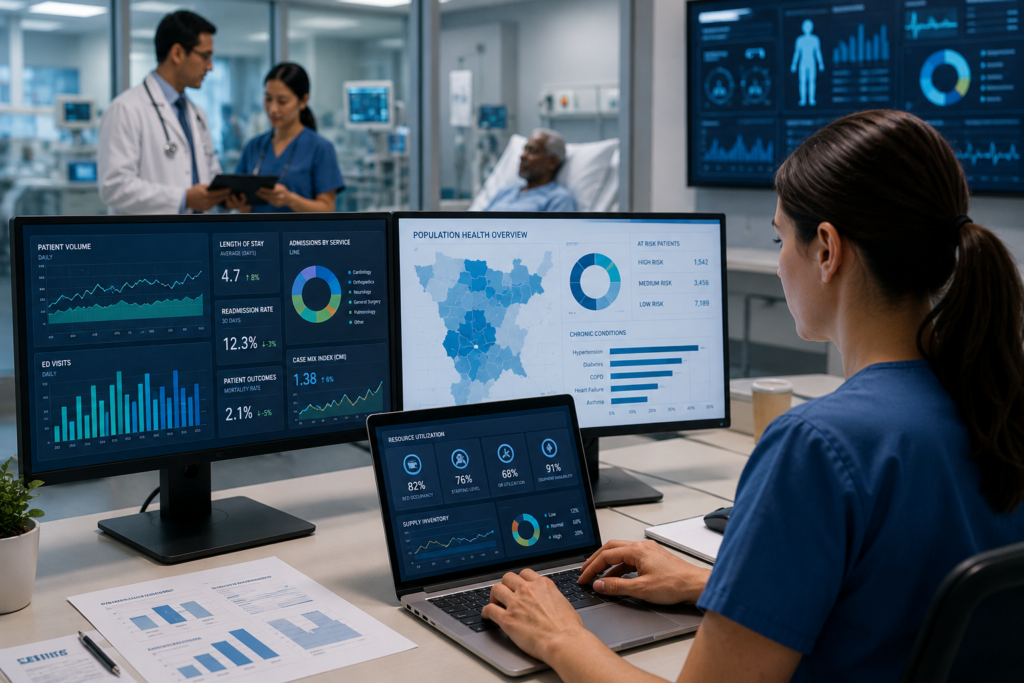
Operational planning is another area where healthcare analytics is commonly applied. Hospitals operate within complex environments that require coordination across staffing, scheduling, supply management, and patient flow.
Staffing and Workforce Planning
Hospitals may analyze patient volume trends, seasonal patterns, and acuity levels to support staffing and scheduling decisions. Analytics tools can assist organizations in evaluating workforce needs and operational planning efforts.
These operational concepts relate to topics explored in:
Using Analytics for Healthcare Inventory Management
Supply Chain and Inventory Analytics
Healthcare analytics may also support inventory tracking, demand forecasting, and supply management processes. These efforts can help healthcare organizations evaluate resource utilization and operational efficiency.
4. Financial and Revenue Cycle Analytics
Hospitals and health systems also use healthcare analytics to support financial operations, reporting, and compliance-related processes.
Claims, Billing, and Revenue Cycle Analytics
Analytics tools may be used to:
- Identify potential billing inconsistencies
- Evaluate claim denial trends
- Support revenue cycle workflow analysis
Cost and Utilization Analysis
Healthcare organizations may use analytics to evaluate utilization trends, service line performance, and operational planning considerations as part of broader organizational decision-making processes.
5. Growing Use of Healthcare Analytics Across Organizations
As healthcare organizations continue investing in digital infrastructure and data-informed processes, the use of healthcare analytics has expanded across a range of clinical and operational functions.
Roles associated with healthcare analytics may include:
- Healthcare data analyst
- Clinical informatics specialist
- Population health analyst
- Healthcare operations analyst
According to the U.S. Bureau of Labor Statistics, employment in medical and health services occupations is projected to grow faster than the average for all occupations. Readers should review BLS materials directly for full occupational details and methodology.
Professionals in healthcare analytics environments may work with areas such as:
- Data mining and predictive analytics
- Healthcare information systems
- Regulatory and compliance considerations
- Translating analytical findings into operational insights
6. Preparing for Healthcare Analytics Environments
As healthcare organizations continue expanding the use of data-driven technologies and analytics tools, professionals with knowledge of both analytics and healthcare operations may find opportunities to contribute across a variety of healthcare settings.
Graduate education can provide exposure to industry tools, healthcare datasets, and applied analytical frameworks used within healthcare environments.
Prospective students can review admissions information here:
Conclusion: Healthcare Healthcare Analytics in Hospitals Analytics in Practice
Healthcare analytics is increasingly integrated into how hospitals and health systems evaluate operations, support patient care initiatives, and inform organizational planning. Real-world applications illustrate how data analysis may contribute to clinical, operational, and financial decision-making across healthcare environments.
For individuals interested in developing healthcare analytics knowledge and technical skills, USF Health Online’s Master of Science in Healthcare Analytics provides an opportunity to explore analytical concepts, healthcare systems, and data-informed decision-making practices used in modern healthcare settings.
National long-term projections may not reflect local and/or short-term economic or job conditions and do not guarantee actual job growth. Information provided is not intended to represent a complete list of hiring companies or job titles, and degree program options do not guarantee career, salary, promotion, or employment outcomes. Students should conduct independent research regarding specific career information and employment conditions.